Why Spare Shooting Raises Your Average
Most bowlers spend almost all their practice time on their strike shot, the shot they already make most often. That is backwards, and here is why.
The Maths That Most Bowlers Ignore
Picture two bowlers. The first throws six strikes in a game but leaves four open frames, no spares converted. Their score lands around 150. The second throws no strikes at all but converts every single spare. Their score comes in around 190.
Zero strikes, 190. That is the actual arithmetic of how bowling scoring works. Spares are worth more than most bowlers realise, and open frames cost more than most bowlers realise. Forty pins sit between 150 and 190, and that is the difference between an average you are frustrated by and one you are proud of.
One extra converted spare a game adds ten pins to your average across a season, without changing your strike shot, your ball, your approach, or anything else about how you bowl.
6 Strikes, 4 Opens
~150
Poor spare conversion
0 Strikes, All Spares
~190
Perfect spare conversion
Spare conversion is not a consolation skill. For most league bowlers, it is the quickest route to a higher average, by a significant margin.
Single-Pin Spares Are the Priority
Single-pin spares are both the most frequent leave in a season of league bowling and, with a proper system, the most makeable. The 10-pin for right-handers and the 7-pin for left-handers get left after good shots more than any other combination. They are also missed more than any other spare in recreational and league bowling.
Most bowlers miss them because of a system problem, not a technique problem. They walk up without a clear starting position, aim vaguely at the pin, and rely on hand-eye coordination to get the job done. Against a straight target on the far side of the lane, hand-eye coordination alone is not enough. You need a repeatable process.
A bowler who raises their single-pin conversion rate from 70% to 90% will, over a full season, add several pins to their average from that change alone. It sounds modest. The impact on your scoresheet is not.
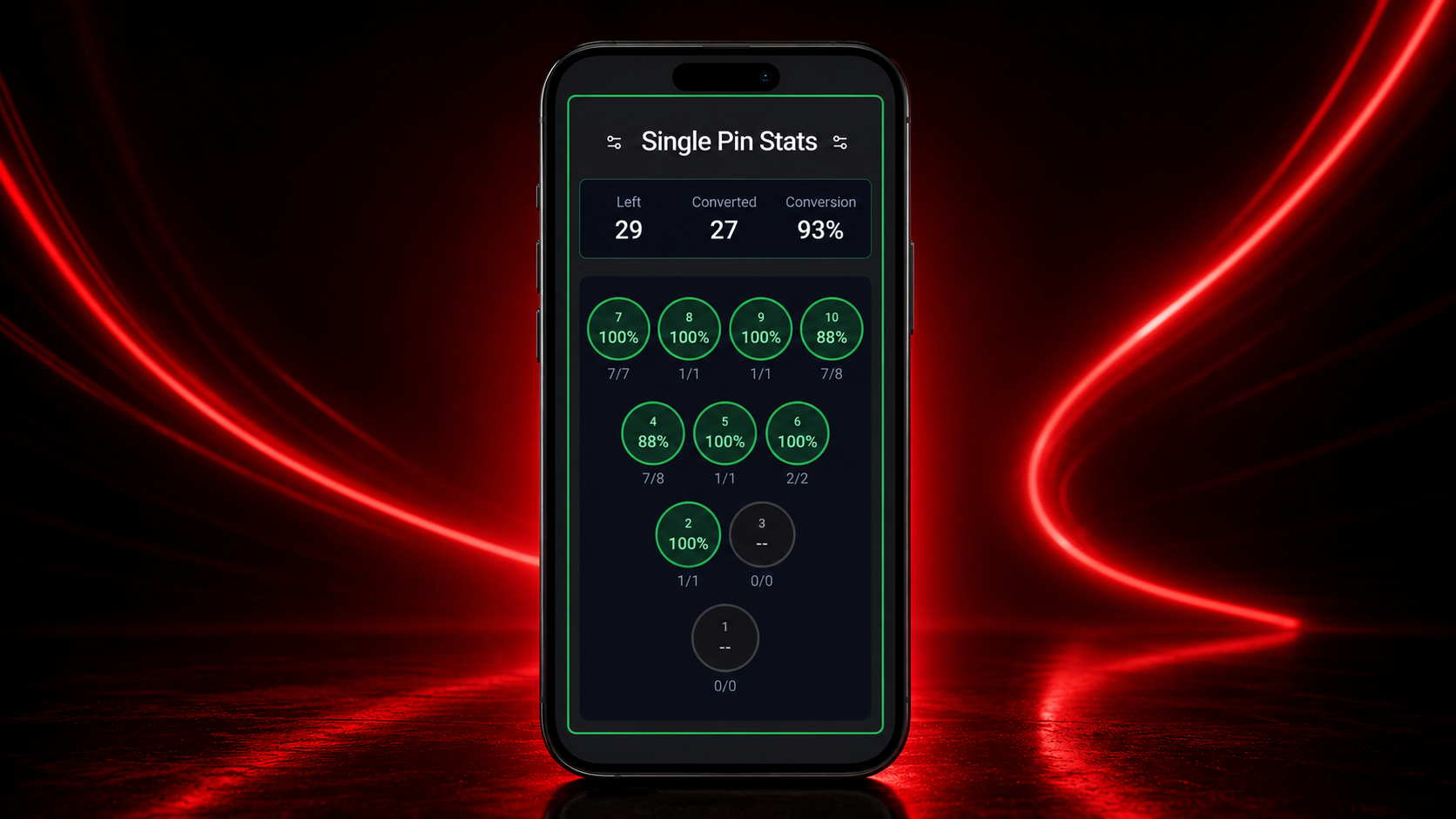
The KB App tracks every single-pin leave and conversion, pin by pin, so you know exactly where your conversion rate is strong and where it is leaking pins.
The 3-6-9 System Explained
The 3-6-9 spare system is the most widely taught spare-shooting framework in league bowling, and for good reason. It is simple, repeatable, and works on the vast majority of house shot conditions without any ball motion calculation.
Here is how it works. When you leave a spare, you keep your target arrow the same as your strike shot, typically the second arrow from the right for right-handers. What changes is your starting position on the approach.
Pin one position across from centre
e.g. the 2-pin or 3-pin
Pin two positions across from centre
e.g. the 4-pin or 6-pin
Corner pin
e.g. the 7-pin or 10-pin
The system removes decision-making from the spare attempt. You see the pin, you know your move, you execute. There is no time spent working out where to aim while standing at the approach, because the system does that thinking for you.
It does have limits. On heavier oil patterns or sport conditions, ball motion can differ enough that a straight spare ball becomes the better choice, particularly for corner pins. Many serious league bowlers carry a plastic spare ball for exactly this reason. But even with your standard ball, the 3-6-9 system gives you a reliable starting point on any house shot.
Any consistent system is better than no system. Consistency is what makes spares repeatable. Improvising is what makes them unpredictable.
Building a Pre-Shot Routine for Spares
Spare shooting needs a different mental approach to your strike shot. Not more intense, just more deliberate. Your strike shot has a rhythm built over years of repetition. For most bowlers, your spare shot does not. That is the gap.
A simple pre-shot routine closes that gap by giving every spare attempt the same structure, regardless of what the leave looks like or what the score says. Here is a framework that works:
Identify the leave
Name the pin or combination clearly in your head. Do not just glance at it. Look at it properly.
Determine your position
Apply your spare system. Know exactly where your feet are going before you move.
Visualise the shot
See the ball travelling over your target arrow and into the pin. Take a breath.
Step up and commit
Walk to your starting position, set up, and execute without hesitation. Hesitation is where spares are lost.
One trap catches a lot of bowlers: rushing the spare after a particularly good first ball. You hit the pocket cleanly, felt great, and want to carry that momentum straight into the spare without slowing down. This is when single-pin misses happen. Your routine exists for exactly this moment. Use it.
What to Practise and How to Track It
Spare shooting improves faster than your strike shot with focused practice, because the task is more predictable and measurable. The pin sits in the same place every time. Your system tells you where to stand. All you are training is repeatability.
The most effective spare drill is straightforward: set up for the 10-pin (right-handers) or 7-pin (left-handers), roll five balls, record how many you convert, reset, and repeat. Do this until you have 50 attempts logged. Your conversion percentage over 50 attempts is your actual number, not the one you imagine you have.
From there, work through your other single-pin spares systematically, then move to two-pin combinations and track conversions for each. You will likely find you are strong on some leaves and consistently weak on specific ones, and that the weak ones are the ones you have never deliberately practised.
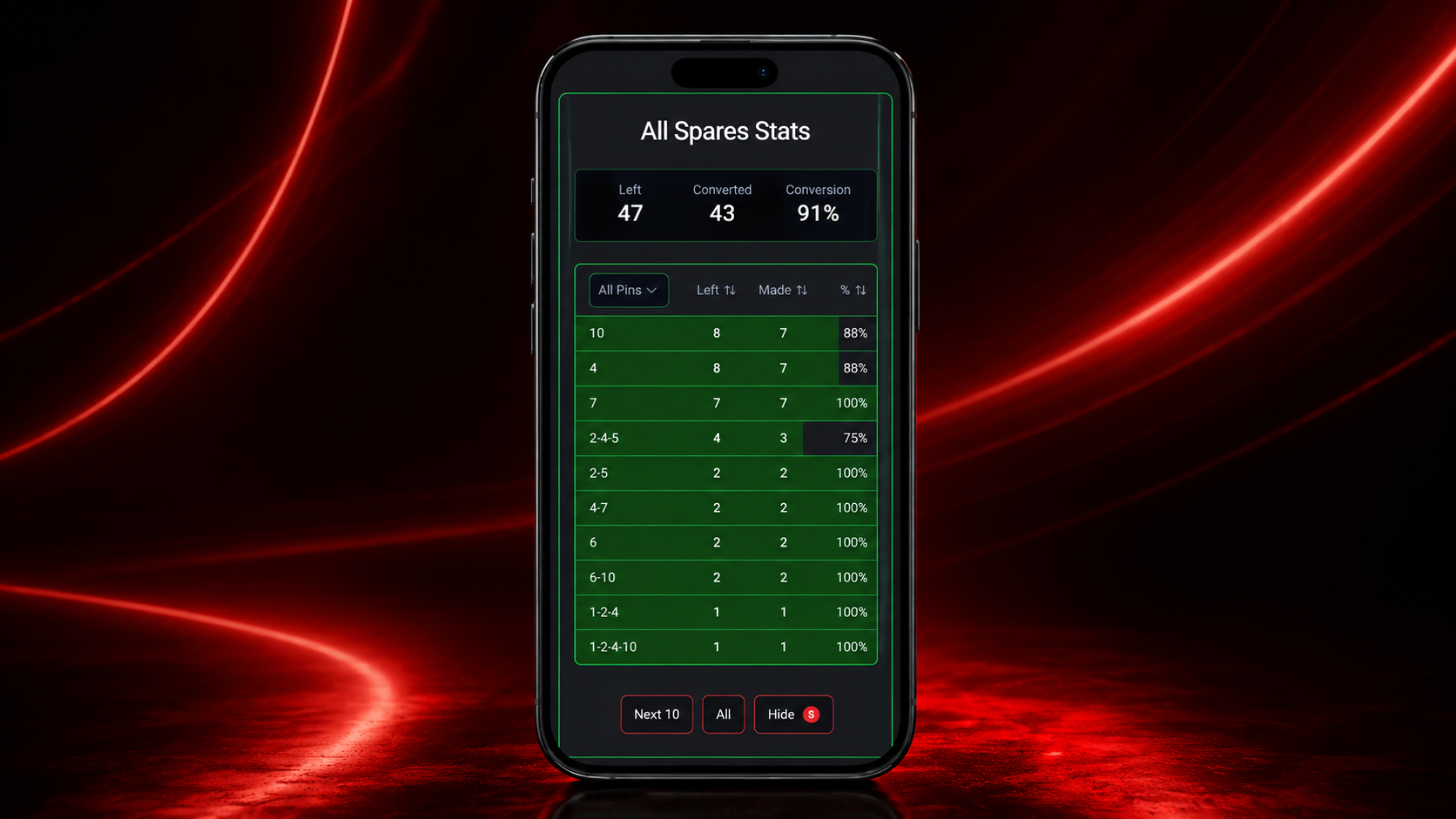
The KB App tracks every spare leave and conversion across all your games, including a ranked list of the spares you leave most often and miss most often.
That is the practice intelligence that turns a vague intention to improve into a specific weekly priority.
The Mental Side of Spare Shooting
Here is something that surprises most bowlers when they hear it: the difference between a bowler who converts 85% of their spares and one who converts 95% is often not physical ability. It is confidence and commitment.
At 85% conversion, the technique is already good enough. The leakage comes from hesitation, from treating certain spares as more important than others, from stepping up to a tenth-frame spare with a different level of focus than a third-frame spare. The bowler at 95% has learned to treat every spare identically: same routine, same target, same commitment, regardless of what is at stake.
This is worth understanding because it changes where you direct your attention. If your spare conversion is below 80%, the priority is building a system and practising it. If you are above 80% but stalling, the priority shifts to mental consistency, specifically maintaining your routine when the pressure is highest.
Bowlers who treat every spare identically, same routine, same focus, frame one or frame ten, will always outperform bowlers who try harder when it matters. Trying harder is not a system.
Three Things to Do This Week
Commit to a spare system and use it every frame.
Choose the 3-6-9 system, learn the positions, and apply it without exception for a full month. Consistency of process matters more than which system you choose.
Find out your actual single-pin conversion rate.
Not the number you think it is. The real one. Fifty attempts, properly tracked. Most bowlers are surprised by what the data shows.
Dedicate at least 30% of every practice session to spare shooting.
Most bowlers spend less than 10%. The bowlers who improve fastest invert this. They treat spare shooting as the main event and the strike shot as the warm-up.
Whether you are averaging 130 or 190, understanding realistic benchmarks helps you set goals that actually drive improvement rather than frustration.
What Is a Good Bowling Average?Know Exactly Which Spares to Work On
The KB App tracks every spare leave and conversion across all your games, by specific pin, by session, and over time. No more guessing which spares are costing you. The data tells you exactly where to focus.
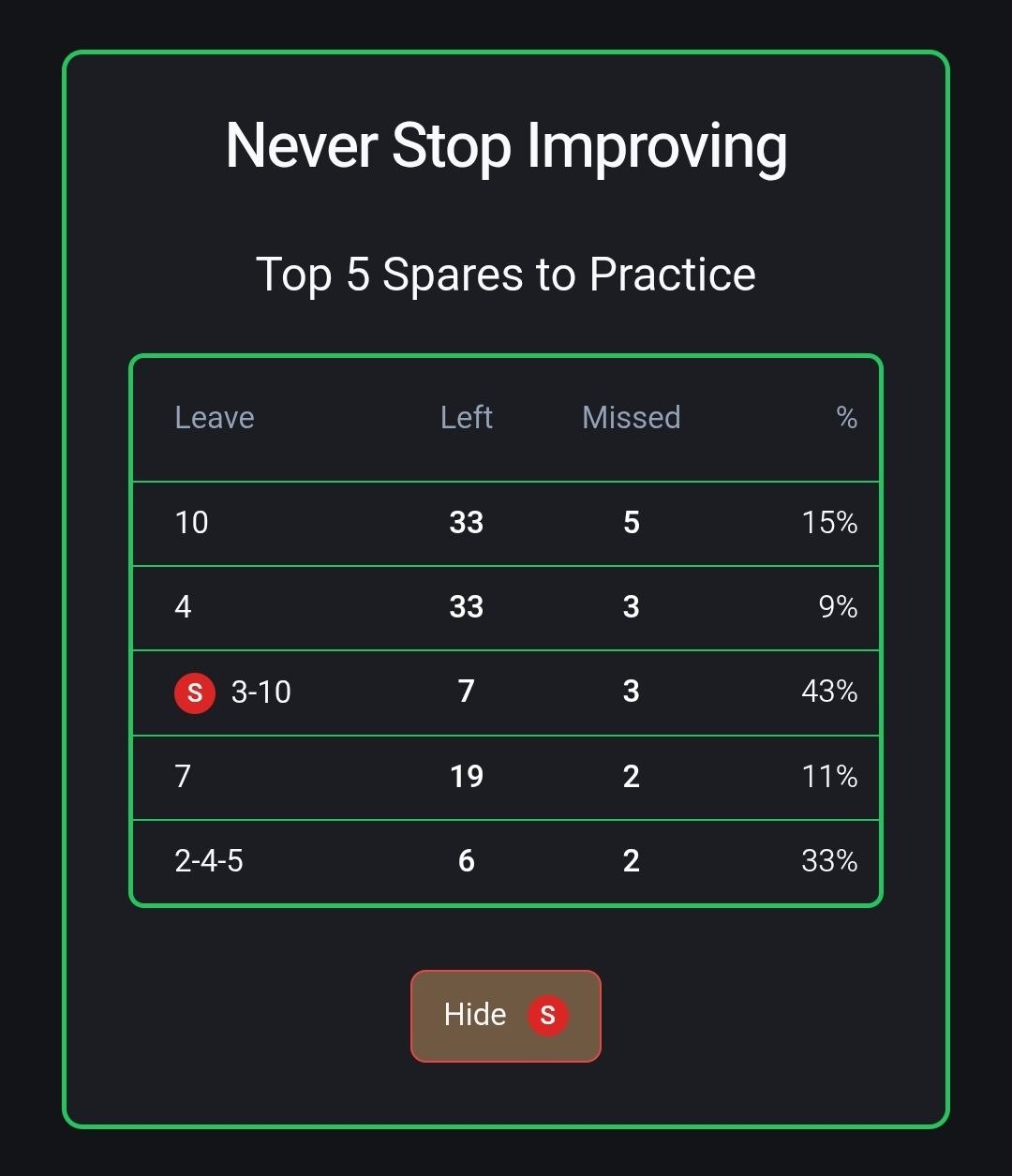
The KB App ranks your five highest-priority spares automatically, so your next practice session starts with a target list instead of a guess.
Start your free 28-day trial. No credit card needed.