What Is a Good Bowling Average?
A 160 average is excellent for a casual bowler and a plateau for a league competitor. The same number means two completely different things.
Before you can improve, you need to know where you actually stand and what a realistic next step looks like.
Bowling Average Benchmarks by Level
The word "good" is almost meaningless on its own in bowling. A 160 average is a genuine achievement for someone who bowls recreationally once a month. For a committed league bowler who practises weekly, it represents a problem to solve.
What follows are realistic benchmarks based on what bowlers at each level typically look like in terms of pocket accuracy and spare conversion, the two statistics that drive an average more than anything else. These are not aspirational targets. They describe what bowlers at each level actually do.
Beginner
70–100
Still learning the basics of delivery and pin carry. Spares are mostly missed. Getting the ball to the pins consistently is the main challenge.
Spare conversion
Below 40%
Pocket accuracy
Irregular
Developing
100–130
Starting to find a repeatable delivery. Some spares convert, but open frames are still frequent. Good nights and bad nights vary widely.
Spare conversion
40–55%
Pocket accuracy
Occasional
Recreational
130–160
A consistent delivery is forming. Strikes happen but are not reliable. Single-pin spares are still the main source of lost pins.
Spare conversion
55–70%
Pocket accuracy
Developing
League
160–190
A solid fundamental game. Hits the pocket regularly and converts most single-pin spares. Strike strings begin to appear. Still loses games to open frames.
Spare conversion
70–85%
Pocket accuracy
60–75%
Advanced League
190–210
Consistent pocket accuracy, strong spare conversion, and the ability to build strike strings. Rarely loses a game to a careless open frame.
Spare conversion
85–92%
Pocket accuracy
75–85%
Elite / Competitive
210+
High-level execution sustained over full games and series. Adjusts to lane conditions, reads ball motion, and rarely leaves avoidable open frames.
Spare conversion
92%+
Pocket accuracy
85%+
One thing these benchmarks make clear: touring professionals averaging 220 to 240 are operating in a different category entirely. Their spare conversion sits consistently above 95%, and their pocket accuracy on heavily oiled sport patterns would make most league bowlers' heads spin. They are not a useful benchmark for improvement-focused league bowling. They are playing a different game.
What Your Average Is Actually Telling You
Your bowling average is a lagging indicator. It reflects weeks and months of accumulated performance, not what happened last Tuesday. That changes how you should read it.
Bowlers often report feeling stuck at a certain average despite working hard on their game. In many cases the improvement is real. It simply has not had enough time to show up in a number calculated across twenty or thirty games. One bad week can mask three good ones. One exceptional night can prop up a shaky run.
This is also why it is worth separating your true average from a hot-streak average. If your last ten games come out at 185 but your season sits at 168, you are a 168 bowler having a good run. The season number is the honest one, and it is the number that tells you where to focus.
Your average does not lie. It just takes time to update. Trust the season number, not the last few games.
What It Takes to Move Between Levels
Each level transition has a different primary driver. Knowing which one applies to you saves a lot of misdirected practice time.
At this level, the main source of lost pins is open frames from missed single-pin spares. Pocket accuracy is developing but inconsistent. Improving spare conversion from 50% to 70% will usually deliver this jump on its own, with no other changes to your game.
Spares are more consistent by now. The limiting factor becomes how often you hit the pocket versus how often you miss it. More pocket hits means more strikes, easier spare leaves, and fewer open frames. This is where deliberate practice on your strike shot starts to pay.
The physical game is largely in place at this level. What separates 190 bowlers from 210 bowlers is the ability to build and close out strike strings, finish the tenth frame cleanly, and hold execution together when the game is competitive. Mental game and pre-shot routine become the primary levers.
Beyond 210, improvement requires reading and adjusting to lane conditions, understanding ball motion and surface preparation, and holding a high standard of execution across a full series rather than a single game.
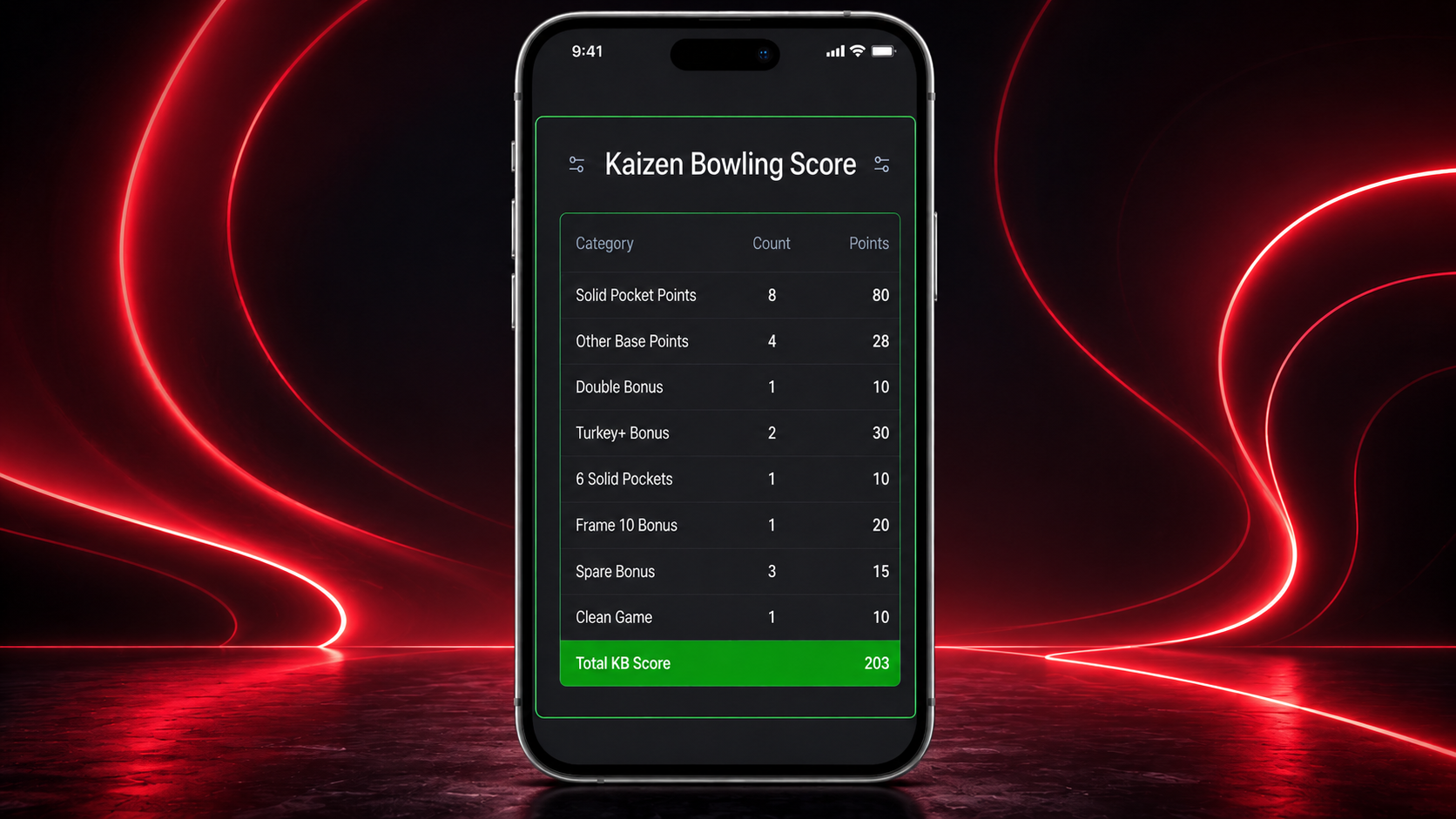
A frame-by-frame breakdown shows your pocket accuracy game by game, so you can see which driver applies to you.
Why Official Score Alone Is a Poor Improvement Metric
Your official bowling score tells you what happened. It does not tell you how well you bowled.
Two bowlers can shoot identical scores through completely different processes. One hits the pocket seven times, converts their spares, and finishes with a 175. The other misses the pocket four times, gets bailed out by fortunate pin carry twice, and also finishes with a 175. Those are not the same performance. One of those bowlers is on their way to a higher average. The other is being flattered by their scoreline.
That is the core problem with using official score as your primary improvement metric. Lucky pin carry, unfortunate splits from good shots, and lane conditions shifting mid-game all create noise that the official score cannot filter out. Over enough games it averages out, but on any given night it can send you completely the wrong signal about how you actually bowled.
This is why KB Scoring exists. Rather than rewarding what fell down, it rewards the quality of the shot you threw. A solid pocket hit scores ten points whether or not it strikes. A miss scores nothing no matter how many pins happen to fall. Over time, your KB Score tracks the real quality of your game rather than the variance around it.
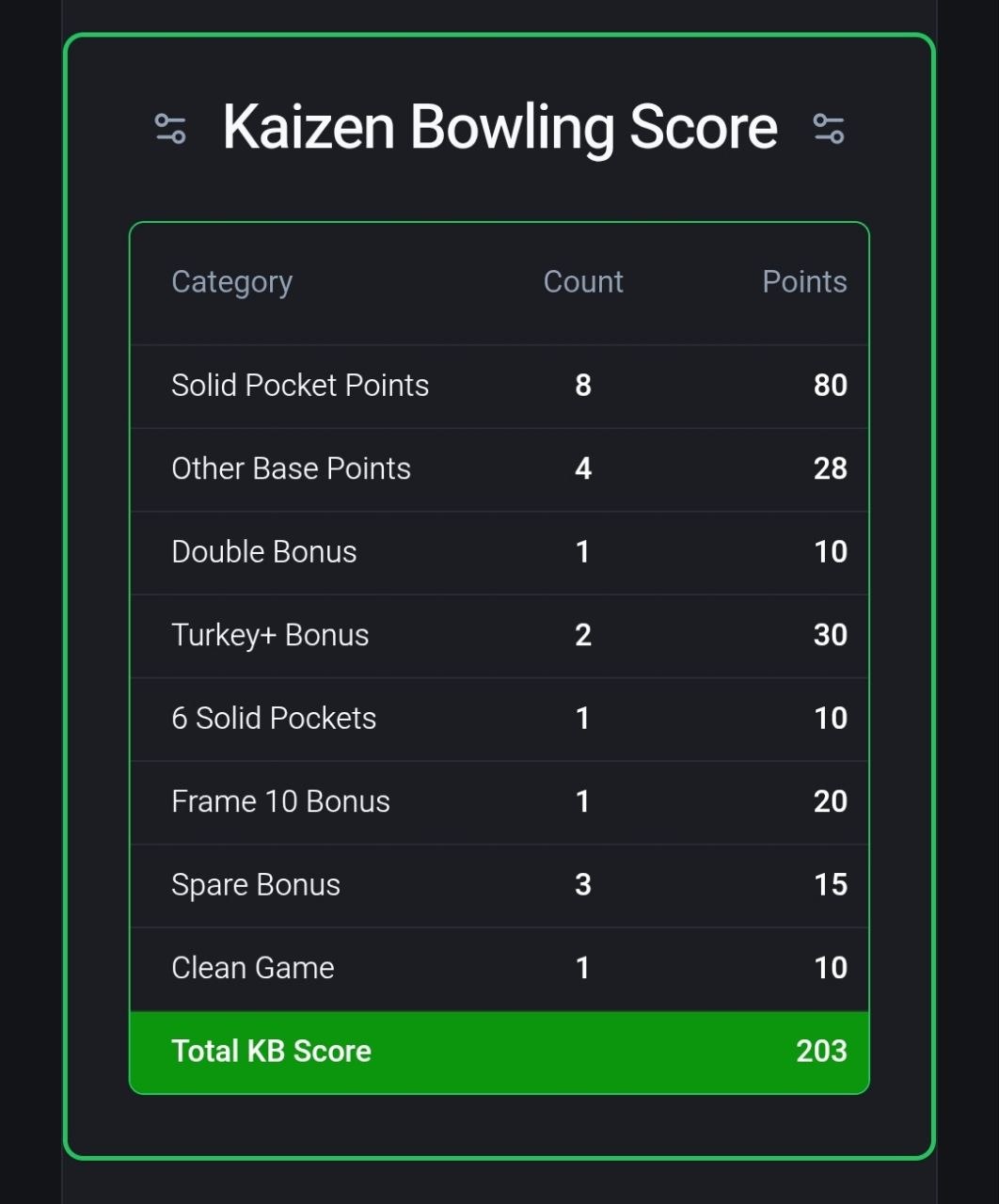
The KB Score sits alongside your official score, so you can see shot quality separately from pin carry.
A bowler with a 168 official average and a consistently high KB Score is performing better than their average suggests. A bowler with a 178 average and a low KB Score is being flattered by variance. Tracking both numbers together makes the picture of your real game considerably clearer.
Setting a Realistic Target
The most useful average target is simple: your current average plus ten pins per season. It sounds modest. Over two seasons it is twenty pins. Over three, it is thirty. A bowler averaging 160 who improves at that rate is a 190 bowler within three years, without dramatic changes to their game, without a coaching overhaul, and without expensive new equipment.
The reason it works is compounding. A 170 bowler hitting the pocket more consistently will naturally start building more strike strings. More strike strings raises the floor on good nights. A higher floor means fewer disastrous games dragging the average down.
What does not work is setting an outcome goal on its own. "I want to average 190 by next season" is a wish, not a plan. The plan is the process that gets you there: improve spare conversion by 10%, raise solid pocket percentage by 15%, bowl at least one clean game in every three league nights. Hit those consistently and the average goal arrives as a byproduct.
Set process goals. Pocket percentage, spare conversion, clean game rate. The average takes care of itself.
Three Things to Take Away
Know your realistic benchmark.
Find yourself in the table above and be honest about it. The right target is the next level up, not three levels up. Improvement that compounds over time beats the attempt to leap.
Measure the inputs, not just the output.
Pocket percentage and spare conversion explain your average far better than the average itself. If you are stuck, one of those two numbers is where the problem lives, and it is usually spare conversion.
Give your average time to update.
Real improvement shows up slowly in an average. If you are doing the right things consistently, the season number will follow.
Now you know where you stand, here is what to work on and in what order to raise the number.
How to Increase Your AverageTrack the Numbers That Explain Your Average
The KB App tracks pocket accuracy, spare conversion, shot quality, and your Kaizen Bowling Score every game. You will know exactly where you stand and exactly what to work on next.
Start your free 28-day trial. No credit card needed.