How to Increase Your Bowling Average
Whether you're averaging 120 and just getting started or sitting at 180 and chasing 200, the path to a higher bowling average is the same: fewer open frames, more pocket hits, and smarter practice.
This guide breaks down exactly what to work on — and in what order.
What Actually Moves Your Average
Your bowling average is simply total pins knocked down divided by games bowled. That means every single pin matters — a missed spare or an avoided split chips away at your number game after game.
The two biggest levers are:
- Spare conversion rate — converting spares consistently is worth more than any number of strikes for most recreational bowlers.
- Pocket hit percentage — the more often your ball enters the pocket (between pins 1 and 3 for right-handers, 1 and 2 for left-handers), the more strikes you'll carry and the easier your spares become.
Everything below feeds into one or both of these.
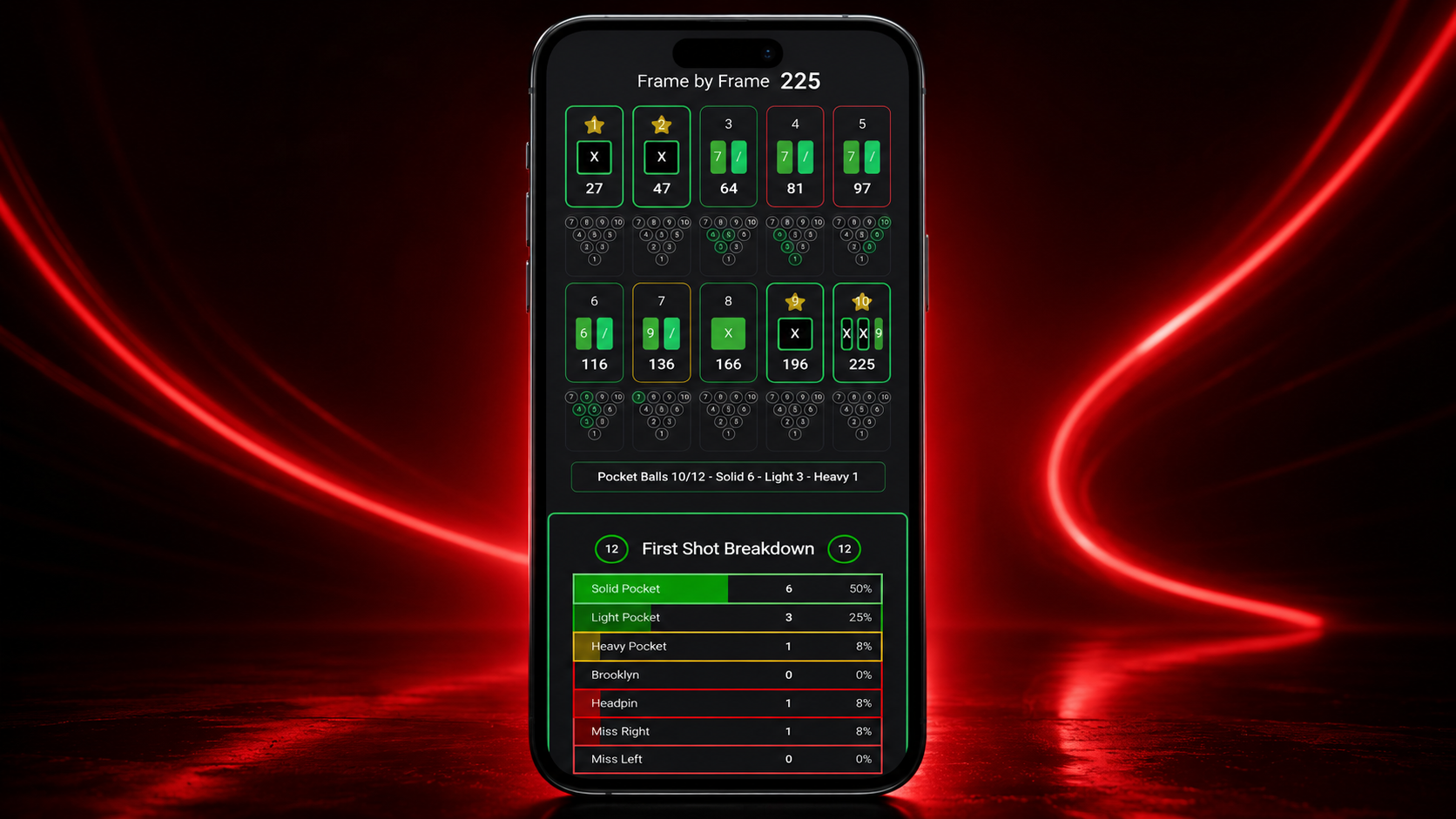
The KB App records pocket hit percentage and spare conversion so you know exactly what to work on.
Tips by Current Average Level
If You're Averaging Under 140
At this stage, the fastest gains come from one place: spare shooting.
Most bowlers averaging under 140 are leaving open frames — shots where they fail to knock down all remaining pins after their first ball. Even without ever striking, a bowler who converts every spare would average around 190. That's how much spare shooting matters.
- Pick up every single-pin spare. The 7-pin and 10-pin are the ones most bowlers miss. Use a straight ball for corner pins if your normal hook makes it unreliable.
- Reduce open frames to 3 or fewer per game. Track this number — it's a better indicator of progress than your average itself.
- Get your own equipment. House balls are one-size-fits-all and often the wrong weight. A properly fitted ball from a pro shop is the single best equipment investment for a developing bowler.
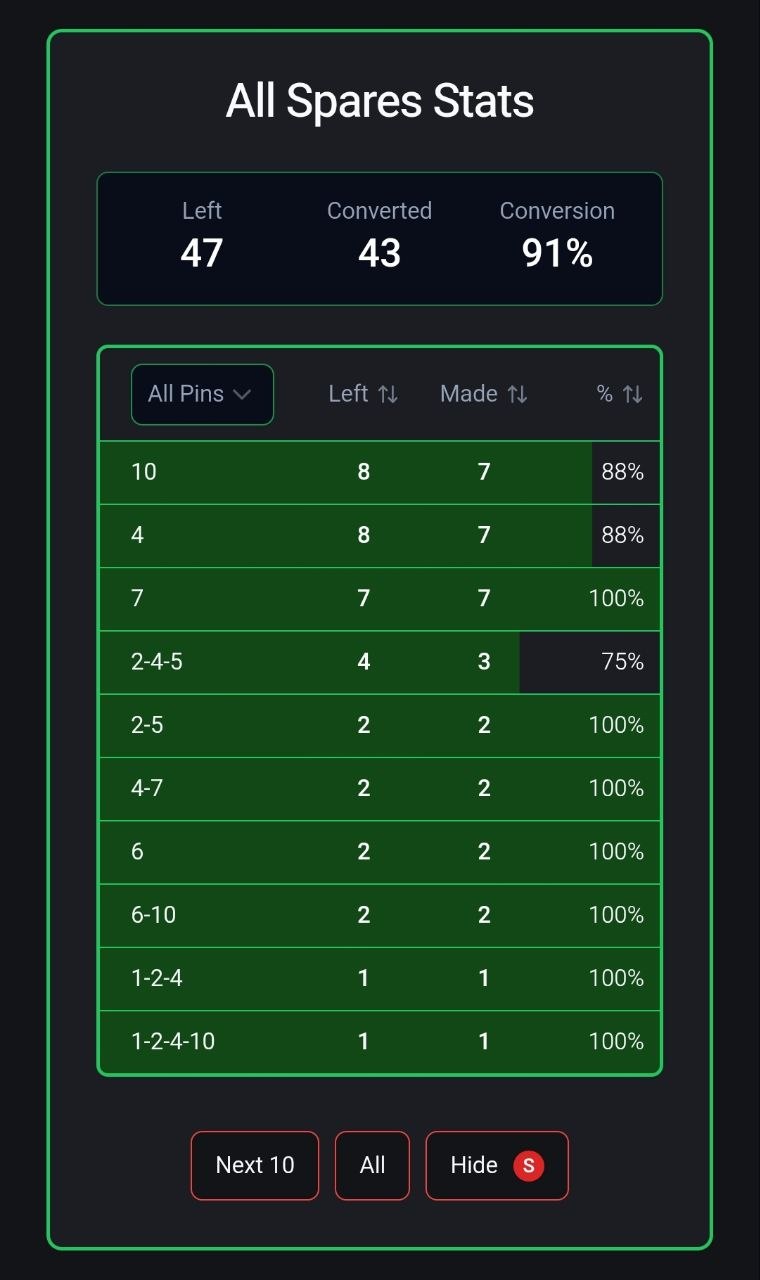
Tracking spare conversion by leave type shows exactly which spares are costing you the most pins.
If You're Averaging 140–175
You're past the beginner stage. You're making most single-pin spares. The gains now come from pocket accuracy and consistency.
- Your starting position and targeting. Hitting the pocket isn't about power — it's about alignment. Work with your pro shop or a coach to identify your optimal starting position and your target at the arrows.
- Ball speed and rev rate consistency. Vary either of these and your ball path changes. Work on delivering the ball the same way every time.
- Lane reading. House shots have oil in the middle and dry outside edges. If your ball is going left (for right-handers), move your feet left. If it's going right, move right.
- Reduce open frames to 2 or fewer per game. At this level, two open frames should be your ceiling.
If You're Averaging 175 and Above
At this level, consistency is your baseline. The gains come from lane play and adjustment.
- Reading oil pattern transitions. Lanes break down during league play — the oil moves and shifts, changing where your ball reacts. The best bowlers adjust to these transitions rather than fighting them.
- A two-ball arsenal. One ball for heavier oil (stronger backend), one for drier conditions or corner pins. Having options means you can adjust to lane conditions rather than hoping they suit your strike ball.
- Targeting your breakpoint. Your breakpoint is where your ball makes its final move toward the pocket. Learn to target this spot rather than just the arrows for more precise adjustments.
- Mental game. At higher averages, a missed spare becomes the difference between a 210 and a 185. Work on resetting between frames and not letting one bad shot bleed into the next.
10 Tips That Apply at Every Level
Track your stats, not just your score
Your score tells you how you did. Your stats tell you why. Tracking pocket hit percentage and spare conversion rate gives you something to work on — not just a number to feel good or bad about. Kaizen Bowling is built specifically for this kind of tracking.
Use a spare ball for corner pins
Hook balls react to friction. Corner pins (7 and 10) have almost no room for error. A straight plastic spare ball eliminates the variable of your hook and makes corner pins dramatically more reliable. This single change adds pins to most bowlers' averages almost immediately.
Master the 3-6-9 spare system
The 3-6-9 system is a targeting method for spares. For every pin further left (for right-handers), move your feet 3 boards left for single pins, 6 for pins in the middle of the lane, and 9 for pins on the far side. It gives you a systematic, repeatable approach to every spare rather than guessing.
Practice deliberately, not just frequently
Rolling game after game on a house shot is comfortable but not efficient. Dedicate at least one practice session per month to pure spare shooting — start from the corner pin positions and work across the lane until you can convert each one reliably.
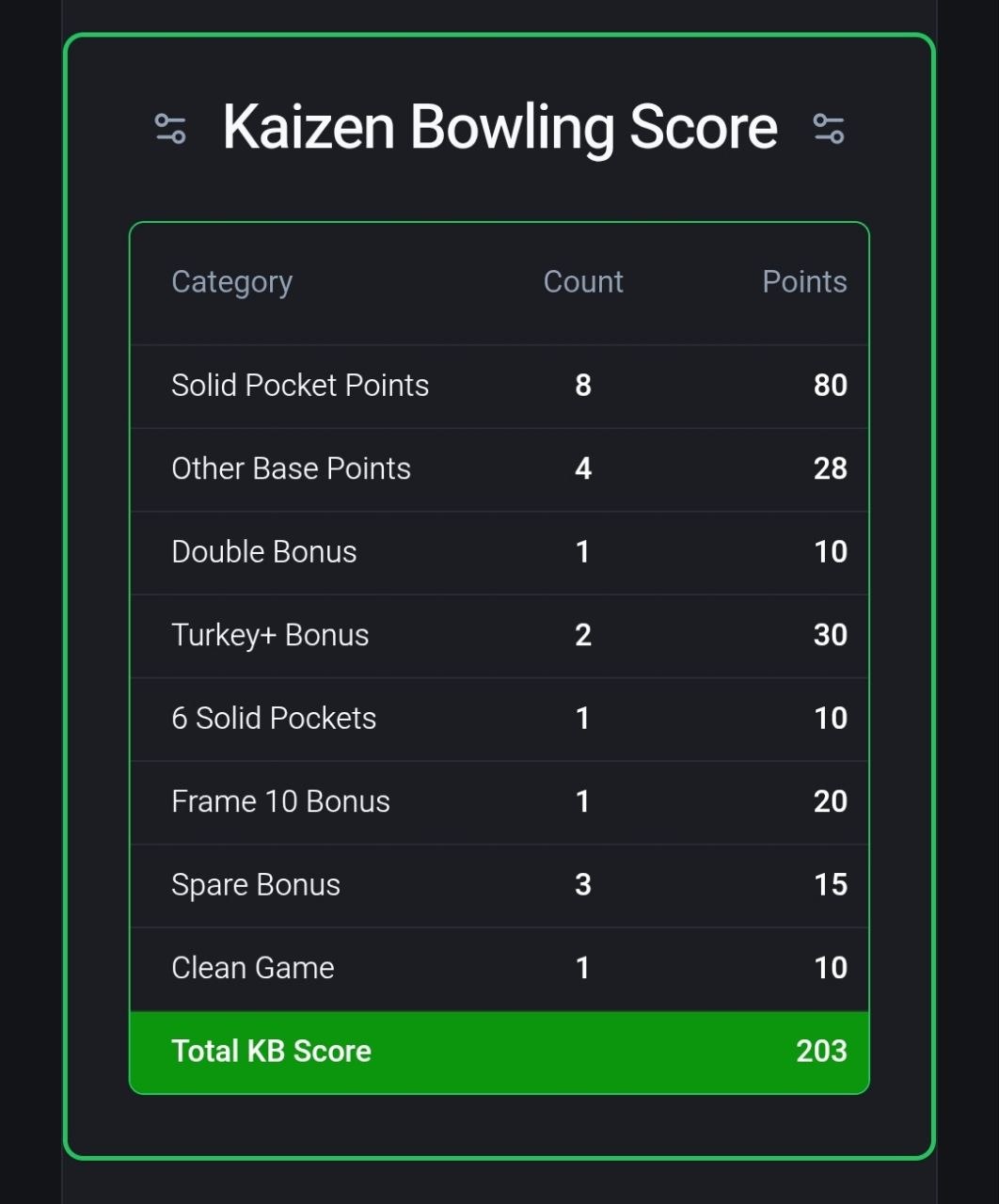
Your KB Score separates shots built on quality execution from shots built on luck — so you know what to repeat.
Clean your bowling ball regularly
A reactive coverstock absorbs lane oil through its pores. After 50–75 games, the ball loses its ability to grip the lane and hook. Wipe your ball after every shot, spray with approved cleaner after every session, and take it for a deep clean (oil extraction) every 50–75 games. A neglected ball performs like a ball two categories weaker than it should.
Check your fit
A poorly fitting ball causes inconsistency. If your thumb is tight, you'll grip the ball and lose your release. If it's too loose, you'll squeeze to hold on. Both kill timing. Get your fit checked at a pro shop at least once a season.
Film your approach
Most bowlers have no idea what their approach looks like. Film yourself (a phone propped on a bag works fine) and look for: timing (is your swing on time with your footwork?), finish position (are you balanced at the foul line?), and release (does your hand come through the ball smoothly?). Even one session doing this reveals things no amount of self-analysis can.
Warm up with purpose
The 10 minutes of practice before league isn't just to loosen up — it's to read the lanes. Note where your ball is starting to hook. Find the dry spot on the outside. Confirm your line. Good teams use the first 5–7 minutes to burn in their desired line, creating a miss area they can aim at all night.
Bowl more games in league conditions
Practice on house shots is helpful but limited. If you can, bowl in multiple leagues or enter tournaments. The pressure, the variable lane conditions, and the need to adjust under competition accelerates improvement faster than any amount of casual open practice.
Get a lesson
Even one lesson with a USBC-certified coach can break a plateau that months of solo practice couldn't touch. Coaches see things about your game that you can't feel yourself. If hiring a coach isn't in the budget, many pro shop professionals will watch a few frames and give informal feedback — ask.
How Long Does It Take to Raise Your Average?
Realistic expectations depend on where you're starting and how deliberately you practice:
| Current average | Realistic gain | Timeframe |
|---|---|---|
| Under 120 | 20–40 pins | 1–2 seasons with focused spare work |
| 120–160 | 15–25 pins | 1 season with consistent practice |
| 160–190 | 10–15 pins | 1–2 seasons focusing on lane play |
| 190+ | 5–10 pins | Ongoing; requires coaching + competition |
The biggest mistake bowlers make is focusing on their average as a whole rather than on the specific things that build it. Fix your spare game first. Add pocket consistency second. Layer in lane play and equipment third. The average takes care of itself.
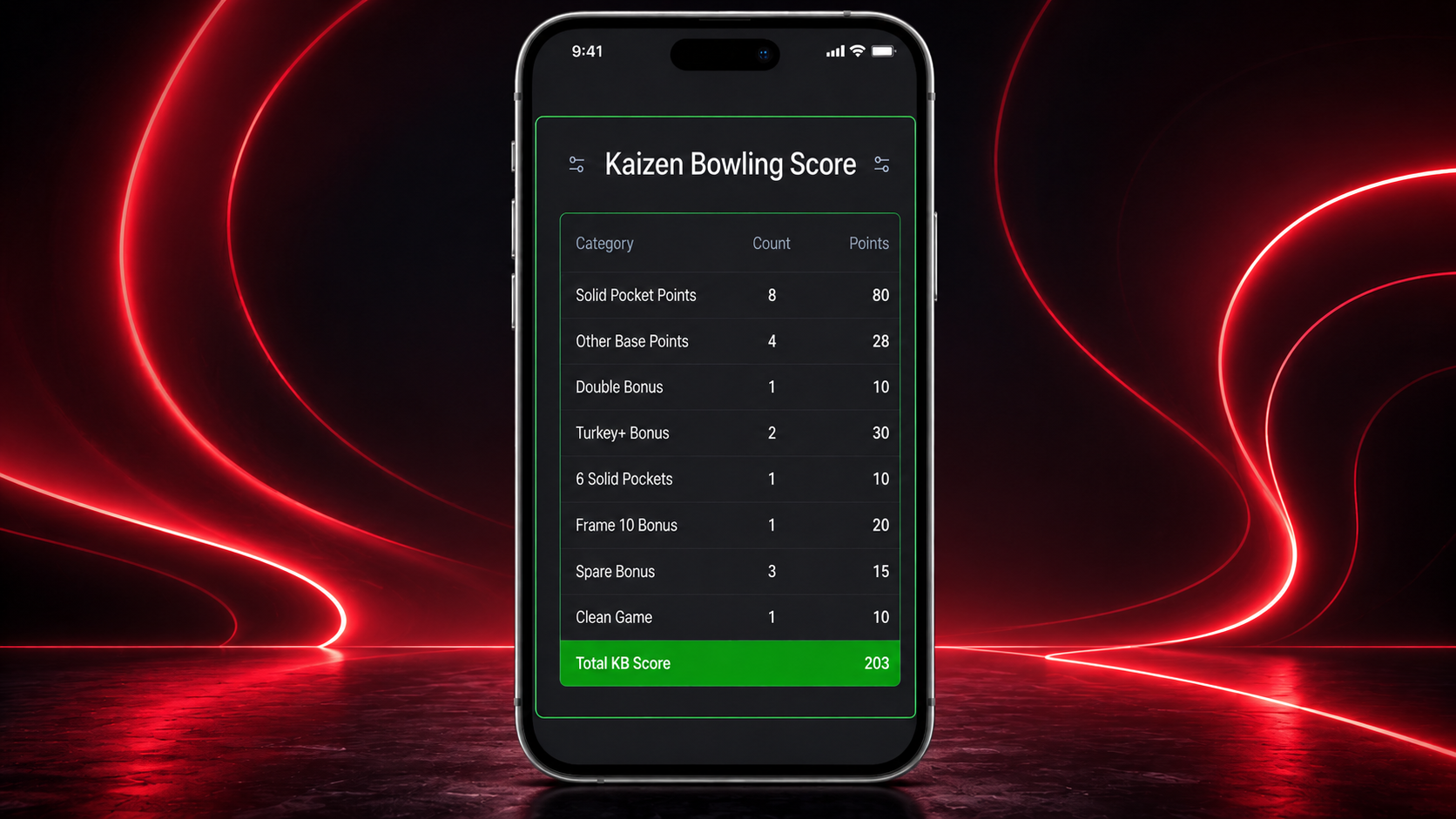
Tracking the right metrics over time makes the progress visible — and keeps you working on the right things.
Fix your spare game first. Add pocket consistency second. The average takes care of itself.
Frequently Asked Questions
How do I increase my bowling average fast?
The fastest gains come from spare shooting. If you're currently leaving open frames, converting them consistently will raise your average faster than any other single change. A plastic spare ball for corner pins is the most immediate equipment upgrade.
How many pins can I realistically add to my average?
Most bowlers who practice deliberately can add 10–25 pins within a season. Beyond 180, gains slow significantly and usually require coaching, better lane-reading, and competition experience.
Does a better bowling ball help your average?
Yes, but only once you have a consistent delivery. A reactive ball used inconsistently is worse than a house ball used consistently. Get your game solid first, then upgrade your equipment.
How do I stop leaving the 10-pin or 7-pin?
Use a straight ball (plastic spare ball) and adjust your starting position. Right-handers: for the 10-pin, move to the far left of the approach and aim at the right side of the lane. The key is eliminating hook from the equation entirely for corner pins.
What bowling average is considered good?
The national league average in the US is around 140–150. Bowlers averaging 170 or above are considered above average. A 200 average is the traditional benchmark for an advanced bowler. But any improvement on your current average is a win.
How long does it take to raise your bowling average by 20 pins?
Most bowlers averaging under 160 can gain 20 pins within a single season with focused work on spare shooting and pocket accuracy. Bowlers averaging under 120 can often gain 20–40 pins in one to two seasons.
Want to understand why your official score doesn't always reflect how well you bowled? Learn about KB Scoring and how it measures true shot quality.
Explore KB ScoringStart Tracking Your Average the Right Way
The KB App gives you the shot-by-shot data you need to understand your game and make real progress — not just a final score.
Start your free 28-day trial. No credit card needed.