How to Break 200 in Bowling
Most league bowlers have shot 200 at least once. Very few average it.
Those are two different problems with two different solutions, and the second one is rarely what people expect.
What a 200 Average Actually Requires
Shooting 200 in a game needs a decent night. Reasonable lane conditions, a few strikes arriving together, nothing going badly wrong. Most bowlers averaging 180 have done it more than once.
Averaging 200 asks for something else entirely. It needs that level of execution to be your baseline, on good nights, ordinary nights, and the nights where the lanes are awkward and nothing feels right from the first shot.
Here is roughly what that looks like in numbers.
50 to 60%
Strike rate
Roughly five or six strikes a game, every game, not just on good nights.
88 to 93%
Spare conversion
Fewer than one missed makeable spare per game.
80%+
Clean game rate
Four games in five finished without a single open frame.
Most 180 bowlers are closer to those numbers than they think on their best nights. The problem is almost never that they cannot bowl at 200 level. It is that they cannot hold it there across a season. That is a different problem, and it has a different fix.
The Strike String Problem
The biggest scoring difference between a 180 bowler and a 200 bowler is not how many strikes they throw. It is where those strikes land on the card. 180 bowlers get strikes. 200 bowlers build strings.
That sounds like a small distinction. In scoring terms it is enormous, because a strike is worth ten plus whatever you knock down with your next two balls.
A strike followed by a spare is worth 20. A strike followed by two more strikes is worth 30. Same shot, same pocket, same ball reaction, and the frame pays half again as much purely because of what came after it. Strung strikes also push that bonus forward into the next frame, so the effect compounds down the card.
This is why one bowler can shoot 195 with eight strikes while another shoots 215 with six. The second bowler grouped theirs into a turkey and a double. The first spread them out.
The ability to follow a strike with another strike is the biggest scoring lever available to a bowler who already hits the pocket.
So what breaks a string? Usually something small and unnoticed. A slightly different starting position after the adrenaline of a strike. A quicker approach. A lane that has transitioned a board or two while you were not paying attention, so the ball is reading earlier than it did two frames ago.
The 200 bowler notices those things. The 180 bowler often notices them once the string is already broken.
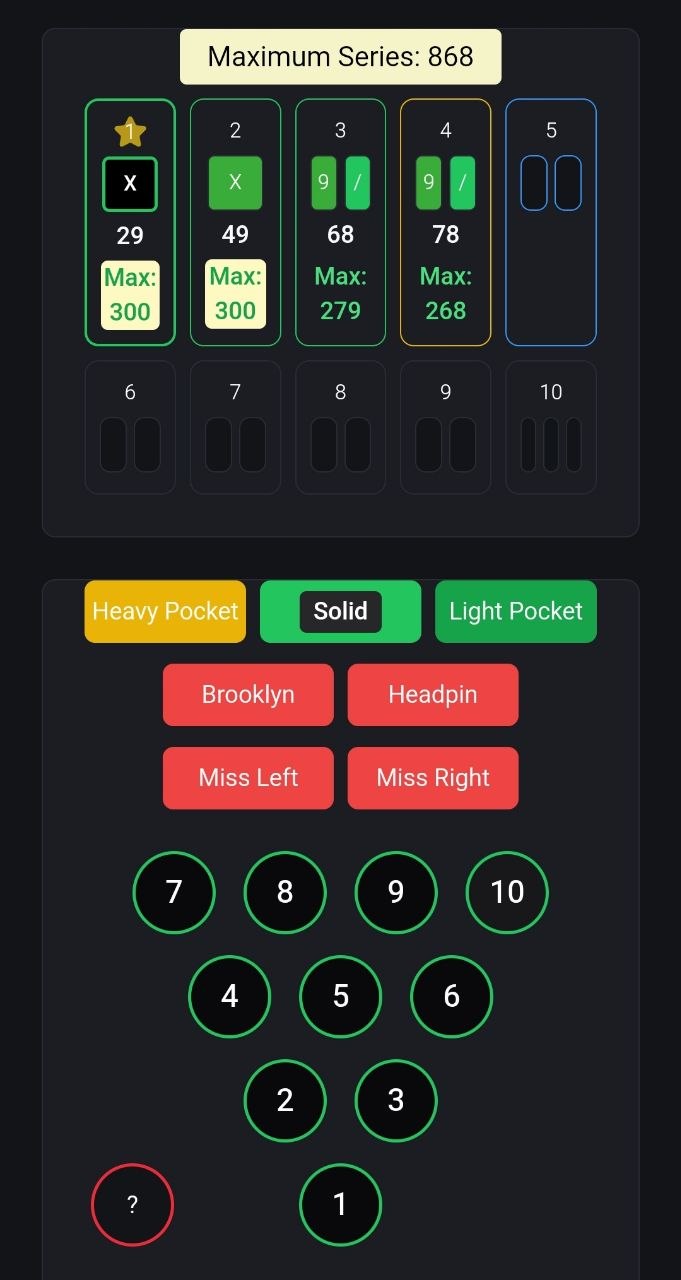
Strike strings are visible frame by frame in the KB App, so you can see where scoring accelerates and where it stalls.
Eliminating the Blow-Up Game
If you average 180 and want 200, the fastest route there is not shooting more 220s. It is getting rid of your 145s.
Both move your average by a similar amount. Against a 180 baseline, a 220 is forty pins up and a 145 is thirty-five pins down, so across a three-game series each shifts the average by roughly a dozen pins in its own direction.
The difference is control. You cannot decide to shoot 220. Carry has to cooperate, the lanes have to suit you, and the strikes have to arrive together. You can absolutely decide to convert every spare on a night when nothing is working, and walk off with 175 instead of 145. One of those two outcomes is a choice. The other is a gift.
Blow-up games have recognisable causes. The most common is a missed single-pin spare early on that starts a spiral. Frustration leaks into the next shot, which misses the pocket, which leaves another awkward spare, which also gets missed. Suddenly it is frame six, there are three open frames on the card, and the game is gone. The damage came from the reaction to the first miss, not the miss itself.
The second most common cause is ignoring lane transition. Oil moves as games are bowled on it. A line that worked in frame two can be wrong by frame seven. Bowlers who do not notice, or notice and keep throwing the same shot hoping for a different result, lose the back end of the game.
Discipline on a bad night looks like this. Your job is not to rescue the game with a heroic back nine. Your job is to convert every spare, hit the pocket as often as you can, and get out with 175. Repeated across a season, that thirty-pin difference is most of the gap between a 180 average and a 195 one.
Raise your floor. The ceiling takes care of itself.
Frame Ten, Where 200 Games Are Lost
Plenty of games that are on track for 200 going into the tenth finish at 187, 191 or 195. Not because the bowler ran out of ability with two balls to go, but because frame ten carries a weight that frames one to nine do not.
You know the score. You know what you need. You step up fully aware of what is at stake, and that awareness is the problem. The moment you are thinking about the outcome instead of the shot, the execution starts to drift.
The fix is easy to describe and genuinely hard to do. Treat frame ten exactly like frame one. Same pre-shot routine. Same target. Same focus on the arrow rather than the pins. Same breath before you start your approach. The frame number is information for the scoreboard, not for your delivery.
Bowlers who average 200 have mostly solved this, and not by caring less. They have made their routine automatic enough that it runs regardless of the stakes. That is the real argument for having a routine at all. If it is inconsistent in frames one to nine, it will not save you in the tenth.
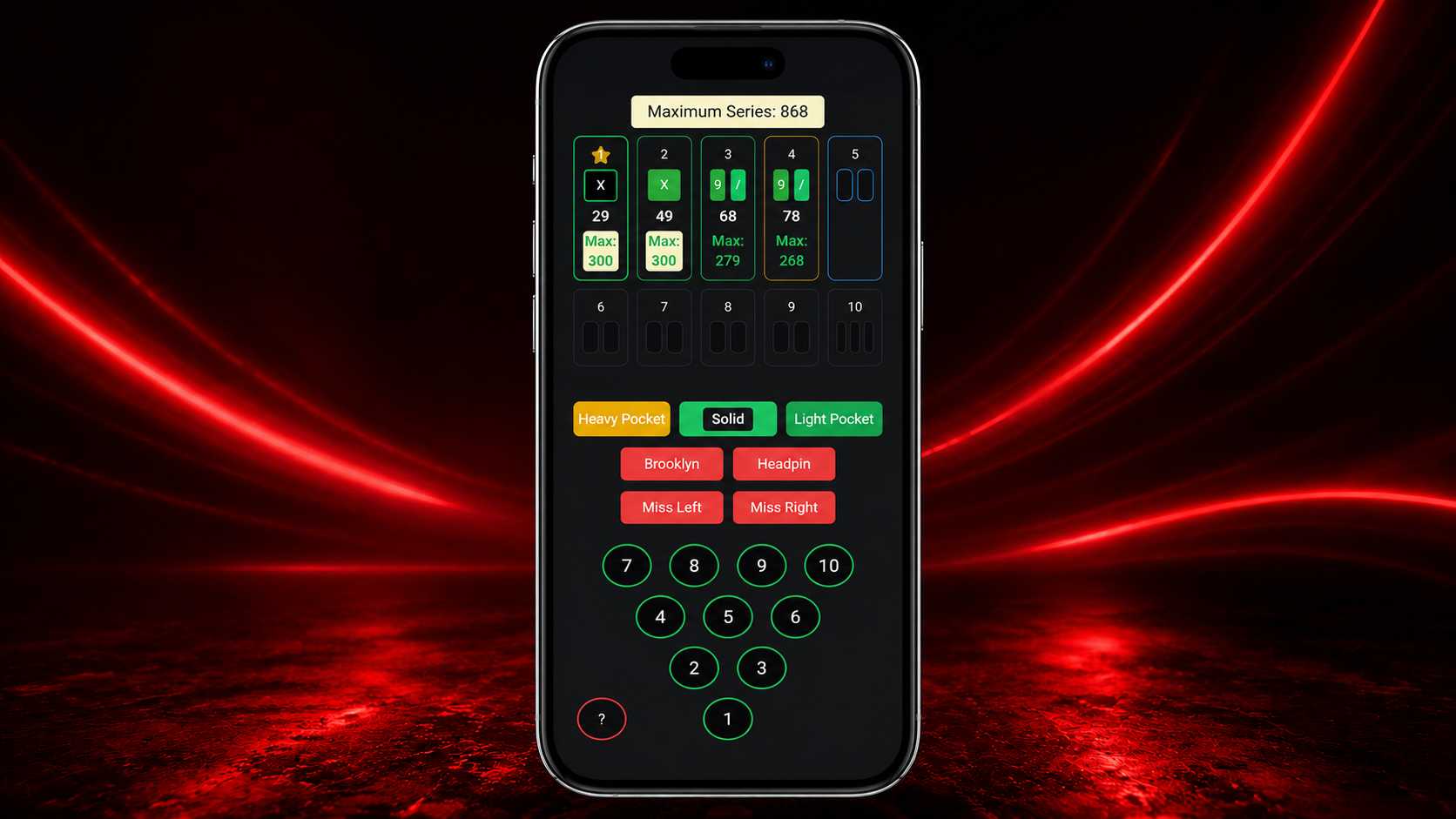
Logging each frame as you go keeps your attention on the shot in front of you rather than the total.
Are You Already Bowling at 200 Level?
Worth asking: is your official average an accurate reflection of how well you are actually bowling?
For some 180 bowlers the honest answer is no. They are hitting the pocket at a 200 level rate and converting spares at a 200 level rate, but a run of splits from good shots, a few difficult lane nights, and ordinary variance in pin carry are holding the number below the performance.
That is what the Kaizen Bowling Score is built to separate. Because it is based on shot quality rather than what fell, it shows the level you are executing at independently of the carry you happened to get. A bowler with a 182 official average and a consistently high KB Score is performing at a level that should produce 195 to 200 over time. The gap tends to close on its own.
The reverse is also worth knowing. A bowler with a 185 average and a consistently low KB Score is being flattered by carry. Their execution is not yet at 185 level, which means a correction downwards is more likely than progress upwards.
Knowing which of those you are changes what you do next. If the process is good, trust it and let the results arrive. If the process is poor, fix the process rather than chasing the score.
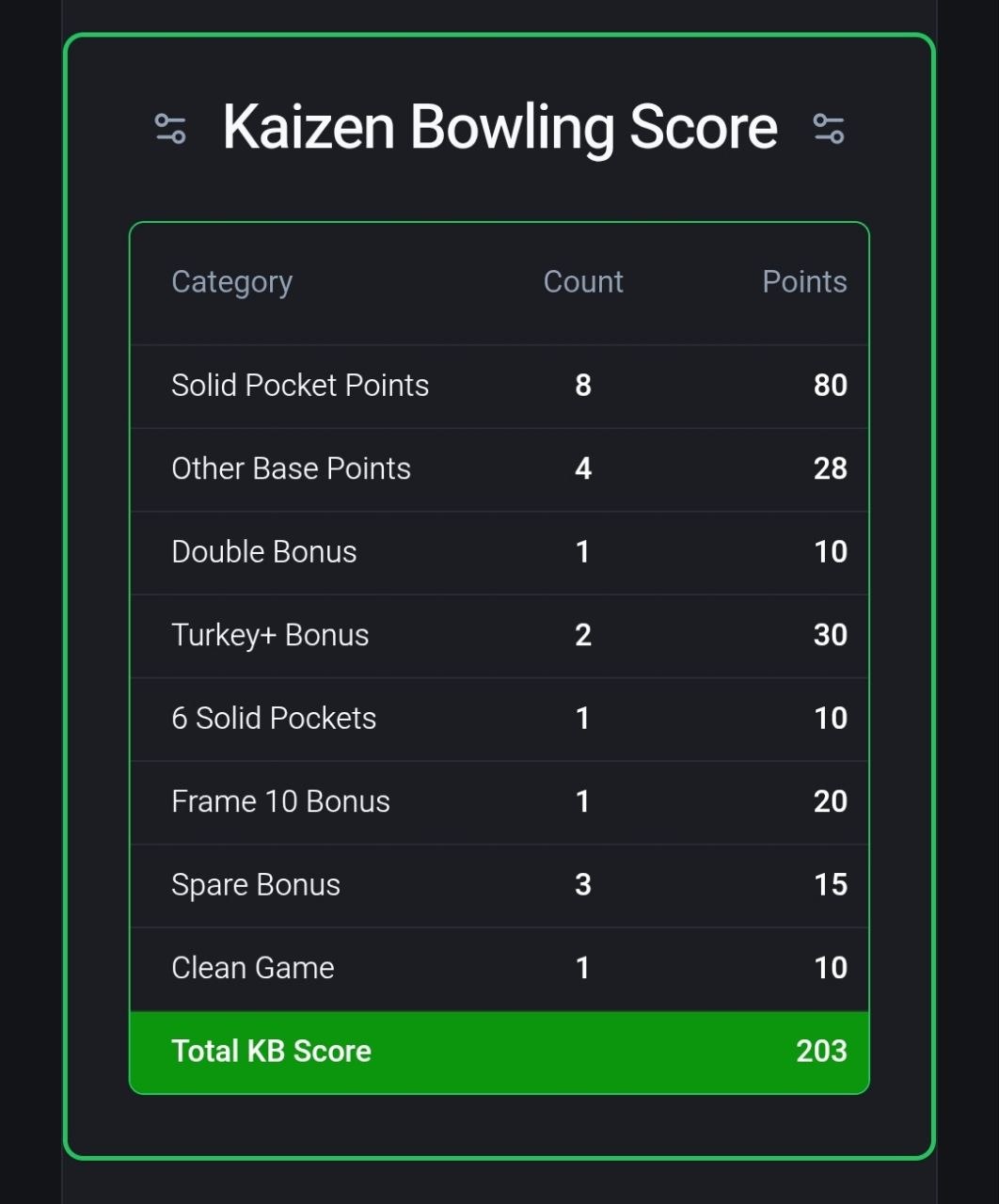
The KB Score measures execution, so you can see whether your average is lagging behind your bowling or running ahead of it.
Three Things to Focus On
Build strings, not strikes.
After a strike, your only job is to repeat the shot that produced it. Same target, same speed, same routine. Grouped strikes are worth far more than the same number spread across the card.
Raise your floor before you chase your ceiling.
You cannot decide to shoot 220. You can decide to convert every spare on a night when nothing is working and walk out with 175 instead of 145. That choice is available every week.
Treat frame ten like frame one.
Same routine, same target, same breath. The frame number is information for the scoreboard, not for your delivery. A routine that wobbles in frames one to nine will not rescue you in the tenth.
Clean games are what hold a 200 average together, and spare conversion is what makes a game clean. Here is the maths and the system behind it.
Why Spare Shooting Raises Your AverageFind Out If You Are Already Bowling at 200 Level
The KB App tracks shot quality, strike strings, spare conversion, and your Kaizen Bowling Score every game. You will see whether your execution is already at 200 level, or exactly what is holding you back.
Start your free 28-day trial. No credit card needed.