The Best Bowling Practice Routine
The bowlers who improve fastest are not the ones who practise most often. They are the ones who practise with a structure.
Here is a complete framework built for league bowlers with limited lane time.
Why Most Practice Sessions Do Not Work
Ask a league bowler what they do when they practise and the answer is almost always the same. They bowl games. Two or three, maybe four, keeping score, trying to shoot well. It gets called practice because it happens outside league night.
Bowling games is not deliberate practice. It is recreational bowling with higher expectations.
The problem is not effort. Most bowlers practising that way are genuinely trying to improve. The problem is structure. When you bowl a full game keeping score, you are doing exactly what you do in league: reacting to whatever leave you face, trying to make each shot, managing the scorecard. Your existing habits run the session, and existing habits do not improve on their own. They just get more repetitions.
Deliberate practice is structured around specific weaknesses. It means focused repetition of the things you are currently bad at rather than the things you are already good at, which makes it less enjoyable than comfortable game bowling and considerably more productive.
A session where you shoot 155 because you spent forty minutes on your corner pin beats one where you shoot 195 bowling the way you always have.
The Four-Block Practice Structure
Ninety minutes split into four blocks covers every component of your game with enough focused repetition to produce measurable change. Here is how the time divides.
Warm-Up and Line Finding
15 minutes
17%›Warm your body up before you bowl a single competitive shot. Shoulder, wrist, legs.
›Bowl three or four frames paying attention to ball path and entry point, not score.
›Confirm your line: starting board, target arrow, and the entry point that combination produces.
›Note any adjustment you need before the structured blocks start.
This block is calibration, not performance. Do not skip it because you think you know where your line is. Confirm it fresh every session.
Spare Shooting
25 minutes
28%›Start with your corner pin. 10-pin for right-handers, 7-pin for left-handers. Throw five balls and record conversions.
›Work through the other single pins: 7, 4, 6, 2, 3. Five attempts each, tracking results.
›Move to two-pin combinations: 4-7, 6-10, 2-4, plus any combination your data flags as a weakness.
›Finish with a pressure set: your weakest spare, five in a row before you move on.
This block should feel harder than it looks. Most bowlers find their single-pin conversion is lower than they believed the first time they track it properly.
Strike Shot and Technique Focus
35 minutes
39%›Choose ONE technical focus for this block. Timing, drift, swing path, or follow-through. Not all of them.
›Bowl with deliberate attention on that single element. Track your pocket position on every shot.
›If the ball is missing consistently in one direction, make one adjustment and judge it over three shots before changing anything else.
›Record pocket position for every first ball. That is your data for next session's diagnosis.
The single-focus rule matters. Working on timing, swing path and follow-through at once produces confusion, not improvement.
Pressure Simulation
15 minutes
16%›Bowl one game keeping official score, using your full pre-shot routine on every delivery.
›Treat every shot as a league shot. No warm-up swings between frames, no relaxed first balls.
›If you leave a spare, apply your spare system with the same process you drilled in Block 2.
›The goal is not a high score. It is replicating league conditions and using your routine under slight pressure.
This block bridges isolated practice and league performance. It is where the habits built in Blocks 2 and 3 get tested in a realistic context.
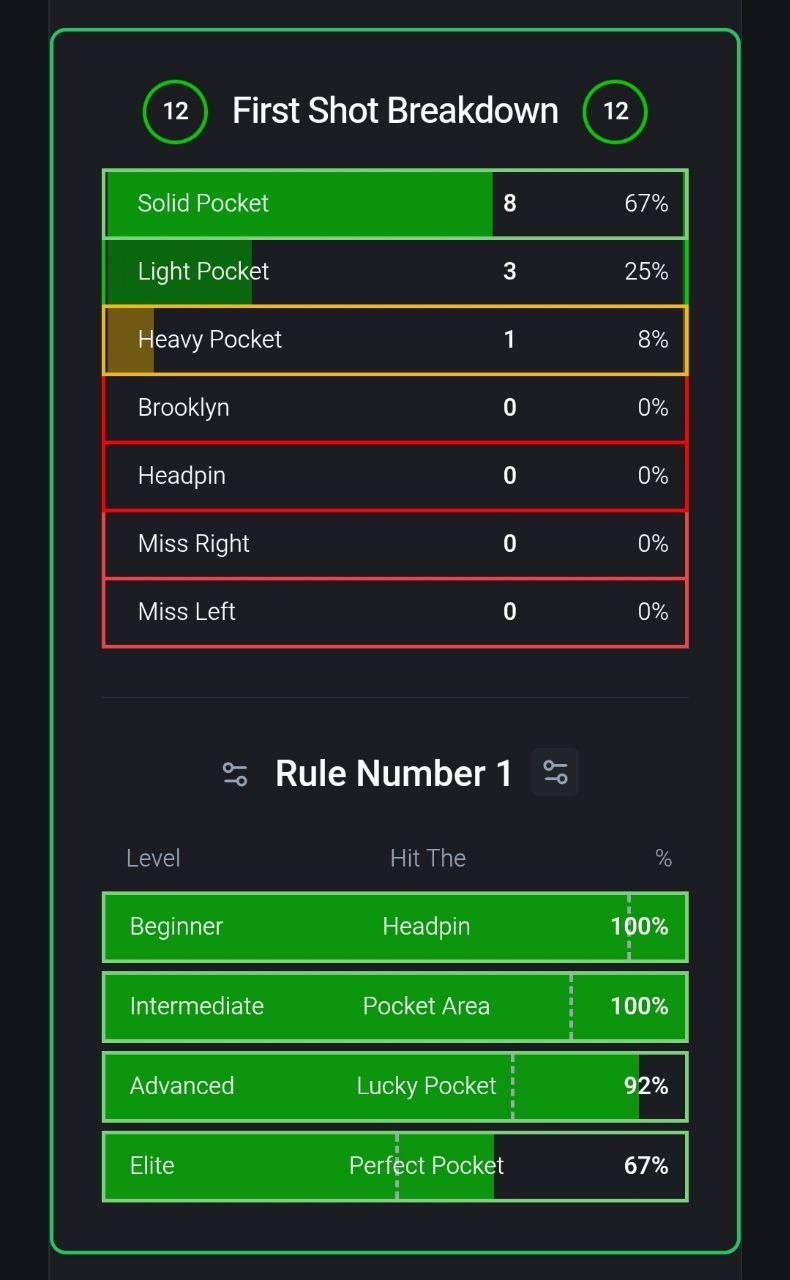
Logging each block as you go turns a practice session into data you can act on next time.
How Often Should You Practise?
For league bowlers who want visible improvement within a season, one or two deliberate sessions a week alongside league night is the sweet spot. That is enough focused repetition to build new habits while leaving recovery time between sessions.
One quality 90-minute session structured as described above will do more for you than three unstructured hours of game bowling. Quality of attention, deliberateness of focus, and the specificity of the feedback loop matter more than the sheer number of shots.
Bowlers who practise more than twice a week often fall into a trap. The extra sessions get less focused as fatigue builds, old habits reassert themselves, and the additional lane time produces diminishing returns. If you only have time for one session a week, make it a well-structured 90 minutes. That is enough to see meaningful improvement across a season.
Once a week
Best option for most league bowlers
One structured 90-minute session produces consistent improvement. Focus on efficiency: short, deliberate blocks rather than extended game bowling.
Twice a week
Ideal if time allows
Session one focuses on technique and spare shooting. Session two focuses on pressure simulation and applying changes under realistic conditions.
Three or more
Only with careful structure
Returns drop off quickly without planning. Additional sessions need a specific, narrow focus rather than general game bowling.
Practising Spares Deliberately
Spare practice is the most neglected part of most league bowlers' routines and the area where deliberate practice pays back fastest. The reason is simple. Spare shooting is predictable and measurable in a way the strike shot is not. The pin is in the same place every time. Your system tells you where to stand. All you are building is the repeatability to execute the same process consistently.
The 50-attempt method is the most effective way to build that repeatability. Choose your weakest spare, usually the corner pin, and throw 50 attempts across one or two sessions, recording every conversion. Your rate over 50 attempts is your actual number. Most bowlers are surprised to find it is lower than they thought.
From there the progression is straightforward. Work through your single-pin spares from weakest to strongest, building each conversion rate over several sessions before moving on to combinations. Single pins, then easy combinations, then difficult combinations, then splits. Do not skip ahead to the hard ones. The foundation of strong spare shooting is bulletproof single-pin conversion, and that has to come first.
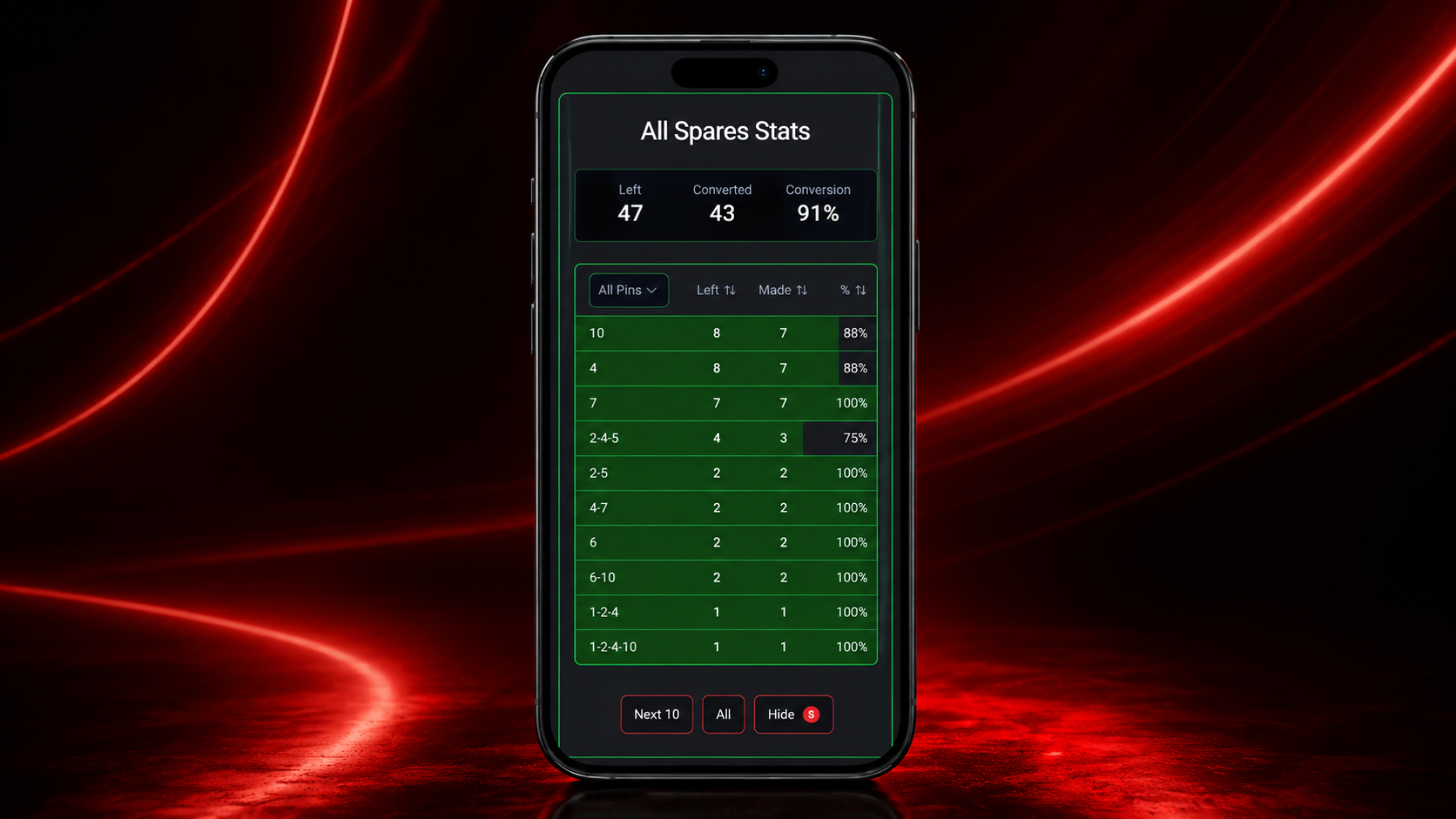
Conversion rates by leave, so you can see which spares are actually costing you pins.
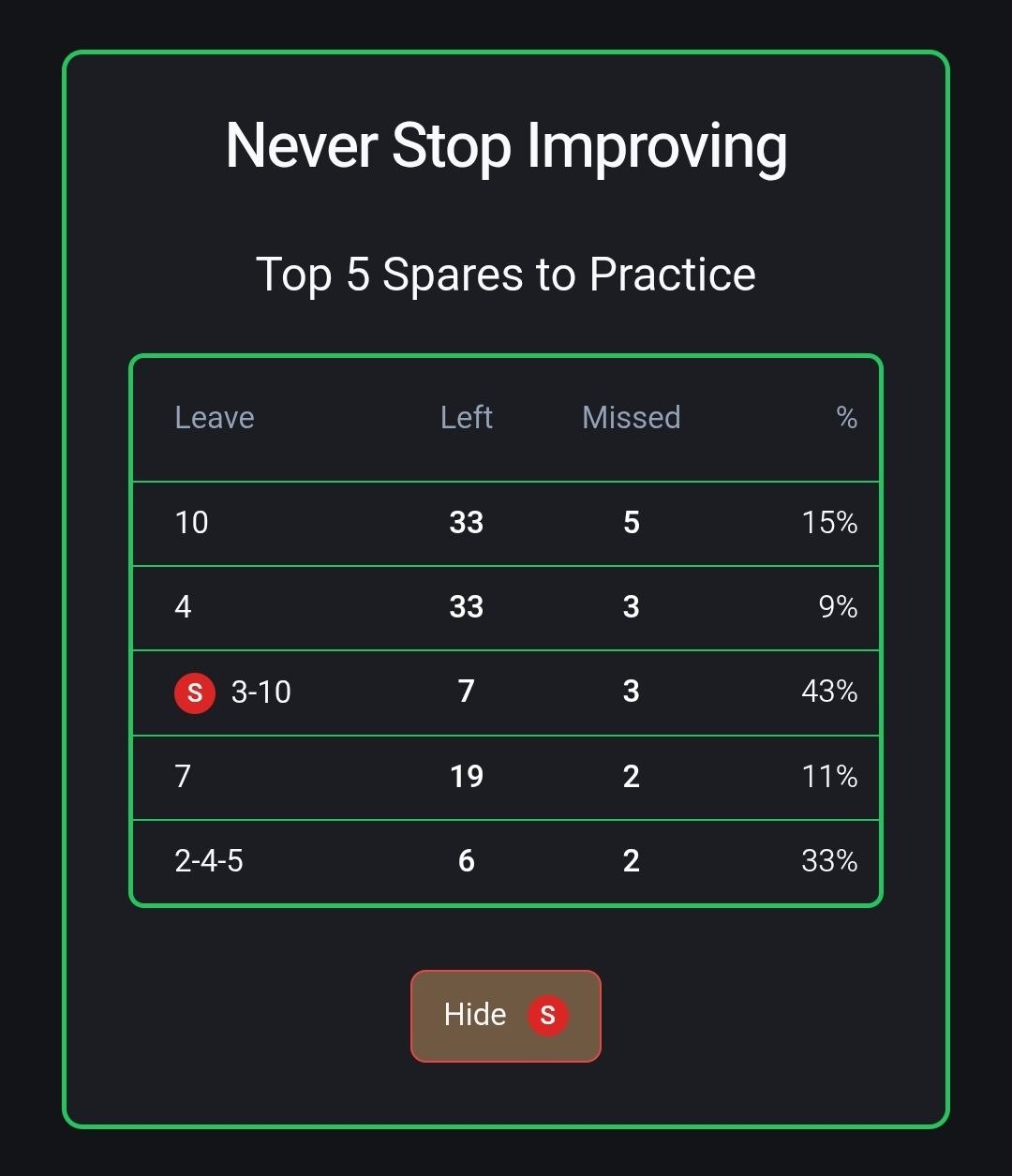
The ranked list is your Block 2 agenda: start at the top, not with the spare that feels most interesting.
The KB App's spare tracking shows every leave and conversion rate across all your games, including a ranked list of the spares you leave most often and miss most. That list is your Block 2 agenda for every session.
Using Your Data to Set Priorities
The difference between a bowler who improves steadily and one who plateaus is often not talent or effort. It is specificity. The improving bowler arrives at the lanes with an agenda based on what their recent sessions are telling them. The plateauing bowler arrives and does roughly what they always do.
Data-driven practice is not complicated. After league night or a practice session, spend three minutes on the numbers. What was your pocket percentage? Was there a consistent miss direction? How was spare conversion against your recent average? What was your clean game rate?
Those answers set the agenda for next session's Blocks 2 and 3. A high miss-left rate means Block 3 works on swing path. A drop in spare conversion means Block 2 expands and identifies which specific spare caused it. A low clean game rate despite good pocket accuracy points at the mental side rather than the physical one.
Bowl, measure, identify, practise specifically, bowl again. That loop is what separates continuous improvement from a permanent plateau. It is not complicated. It just takes the discipline to track the data and the honesty to act on what it shows.
Arriving without an agenda means arriving to reinforce your existing habits. Arrive with a question instead.
Three Things to Change
Structure every session into blocks.
Warm-up and line finding, spare shooting, strike shot and technique focus, pressure simulation. In that order, every time. Structure is what turns game bowling into deliberate practice.
Give close to a third of every session to spares.
Most bowlers give it under 10%. The fastest route to a higher average runs through spare conversion, and spare conversion only improves with deliberate, tracked repetition. Hoping you make them in games is not practice.
Arrive with a specific agenda every time.
Review your data before you go to the lanes. Know what Block 3 is focused on before you get there. A bowler with a specific question to answer improves faster than one who is rolling shots.
Block 2 is close to a third of every session for a reason. Here is the maths behind why spare conversion moves your average faster than anything else.
Why Spare Shooting Raises Your AverageArrive at Every Session With a Specific Agenda
The KB App tracks pocket accuracy, spare conversion by pin, shot quality, and clean game rate across every session. Review your data before practice and you will always know exactly what to work on, rather than what feels right to work on.
Start your free 28-day trial. No credit card needed.