How to Keep Score in Bowling
The machine at the end of the lane does the arithmetic for you. Knowing how to fill in a score sheet yourself is still worth having, because it is how you read a league sheet, check a total, and keep a record the machine will not keep for you.
Here is the whole thing: the boxes, the symbols, the running total and the tenth frame.
What a Score Sheet Looks Like
A ten pin bowling score sheet is a row of ten frames. The printed grid is the score sheet, and a bound set of them is a score book, which is what most UK and US league bowlers carry.
Every frame has the same two parts. Along the top are small boxes for what each ball did, two of them in frames one to nine. Below that is one larger box for the running total of the game to that point.
The tenth frame is the exception. It has three small boxes, because a strike or a spare there earns you bonus balls that have to be recorded somewhere.
That is the entire layout. Ten frames, two small boxes and a big one, with a third small box at the end.
Small boxes record what happened. The big box records where you are.
The Symbols, and What Each One Means
Scoring notation is shorthand, and it is the same shorthand in UK leagues and under USBC rules in the States. Six marks cover almost everything you will ever need to write down.
Strike
All ten pins down with the first ball of the frame. The frame ends there, so the second small box is not used.
Spare
All ten pins down using both balls of the frame. It always goes in the second small box, whatever the first ball was.
Pin count
A plain number is simply how many pins that ball knocked down. Pins down, never pins left standing.
Miss
A dash means that ball knocked nothing down. Some sheets use G for a ball that went in the gutter and a dash for one that missed the pins on the deck.
Foul
Your foot crossed the line. The ball counts as a delivery and scores zero, even if pins went down.
Split
A circle round the first ball count records that the standing pins were split. It does not change the score, it just marks the frame for later.
One point of genuine variation is worth knowing about. On traditional printed sheets a strike is marked in the second small box, because the first ball took everything and the convention grew up around leaving the first box clear. Many modern score books simply put the X in the first box instead. Neither is wrong. Pick one and stay consistent within a sheet, so that anyone reading it later can follow what you did.
Filling In a Frame
Four steps, repeated ten times. The only one that trips people up is the third.
First ball in the first small box
Write the number of pins it knocked down. If it took all ten, write X and the frame is finished.
Second ball in the second small box
If the two balls together cleared all ten, write a slash rather than the pin count. Otherwise write the number of pins that second ball took.
Leave the big box empty until you can fill it
A strike or a spare cannot be totalled yet, because the bonus depends on balls that have not been thrown. This is the single most common place a hand-kept sheet goes wrong.
Carry the running total forward
The big box holds the running total for the game so far, not the score for that frame on its own. Each frame adds to the one before it.
Working Out the Running Total
Three rules cover every frame you will ever score.
An open frame, where pins are left standing after two balls, is worth exactly the number of pins you knocked down. A spare is worth ten plus whatever your next single ball takes. A strike is worth ten plus whatever your next two balls take.
That is why a strike is worth somewhere between 10 and 30, and a spare somewhere between 10 and 20. It is also why the big box has to wait. You cannot fill in a strike until two more balls have been thrown.
Worked example
Frame 1, a strike. Ten pins, plus the next two balls. Those turn out to be a 7 and a 3, so frame 1 is 10 + 10 = 20. The big box reads 20.
Frame 2, 7 then a spare. Ten pins, plus the next single ball. That turns out to be a 4, so the frame is worth 14. Added to the 20 already there, the big box reads 34.
Frame 3, 4 then 2. An open frame, worth the 6 pins it knocked down. Added to 34, the big box reads 40.
Notice that frame 1 could not be written down until the second ball of frame 2 had been thrown. Working two frames behind is normal, not a sign you have lost track.
If you want the rules themselves worked through in more depth, including why strikes compound the way they do, our official bowling scoring guide covers it frame by frame.
The Tenth Frame
The tenth frame exists so that a strike or spare at the end of the game still gets the bonus balls it has earned. It has three small boxes, and you fill them left to right in the order the balls were thrown.
Throw a strike with your first ball and you get two more. Clear the ten across your first two balls for a spare and you get one more. Leave pins standing after two balls and the game simply ends, with the third box unused.
Those extra balls are bonus deliveries, not a new frame. They count towards the tenth frame's score and nothing else, which is why a perfect game is twelve strikes rather than ten. Nine frames worth 30 each comes to 270, and the tenth frame with its two bonus balls adds the last 30, for 300.
Three boxes, filled left to right, in the order you threw the balls.
Where Hand-Kept Sheets Go Wrong
Almost every scoring error is one of five things, and two of them happen in the big box rather than the small ones.
Totalling a strike or spare too early
The fix
Leave the big box blank and come back to it once the bonus balls have been thrown. Two frames can sit unfilled at once without anything being wrong.
Writing the frame score instead of the running total
The fix
The big box is cumulative. If frame one is 20 and frame two is worth 14, frame two reads 34, not 14.
Recording pins left standing
The fix
Always write pins knocked down. It sounds obvious, and it still catches people who are used to calling out what is left on the deck.
Marking a spare in the tenth as a strike
The fix
In the tenth the boxes fill left to right in the order the balls were thrown. A slash goes in the box for the ball that completed the ten, not in the first.
Forgetting a foul still counts as a delivery
The fix
An F in the first box means the second ball is still your second ball. After a foul on the first ball the pins are reset, so the frame is a spare only if the second ball knocks down all ten.
What Else Is Worth Writing Down
A finished score sheet tells you what you scored. It does not tell you much about why, and that is the gap worth closing if you are bowling to improve rather than just to play.
The things that actually explain a score are the ones the grid has no box for. Which spares you left and which you converted. Whether your misses went left or right. What the lane was doing by the third game. How the pocket hits were looking even in the frames that did not strike.
That is what a score book is for. Our Bowling Score Book is a standard scoresheet for up to five bowlers, with handicap, frame boxes and totals, plus space for the date, the lane and its condition, the ball you used, total strikes, total spares and notes.
The Not A Bowling Score Book leaves the pinfall to the lane screen. For each frame you circle how the ball hit the pocket, whether you made the spare and how well you were concentrating, and note any target move or ball change. Each game ends with pockets hit and spares missed, and each series ends with lessons learned against your previous best. Over a season either book turns into a record you can read back rather than a stack of totals.

A score book keeps the game and the reasons for it in the same place.
Browse the Kaizen Bowling score books if you prefer pen and paper.
If you would rather not do the writing at all, the KB App scores the game automatically as you tap in each shot. The arithmetic takes care of itself, and the shot detail you would otherwise have to scribble in a margin gets recorded as structured data you can look back over across a season. If you would rather keep everything digital and see a full range of stats at the press of a button, the KB App is the right choice for you.
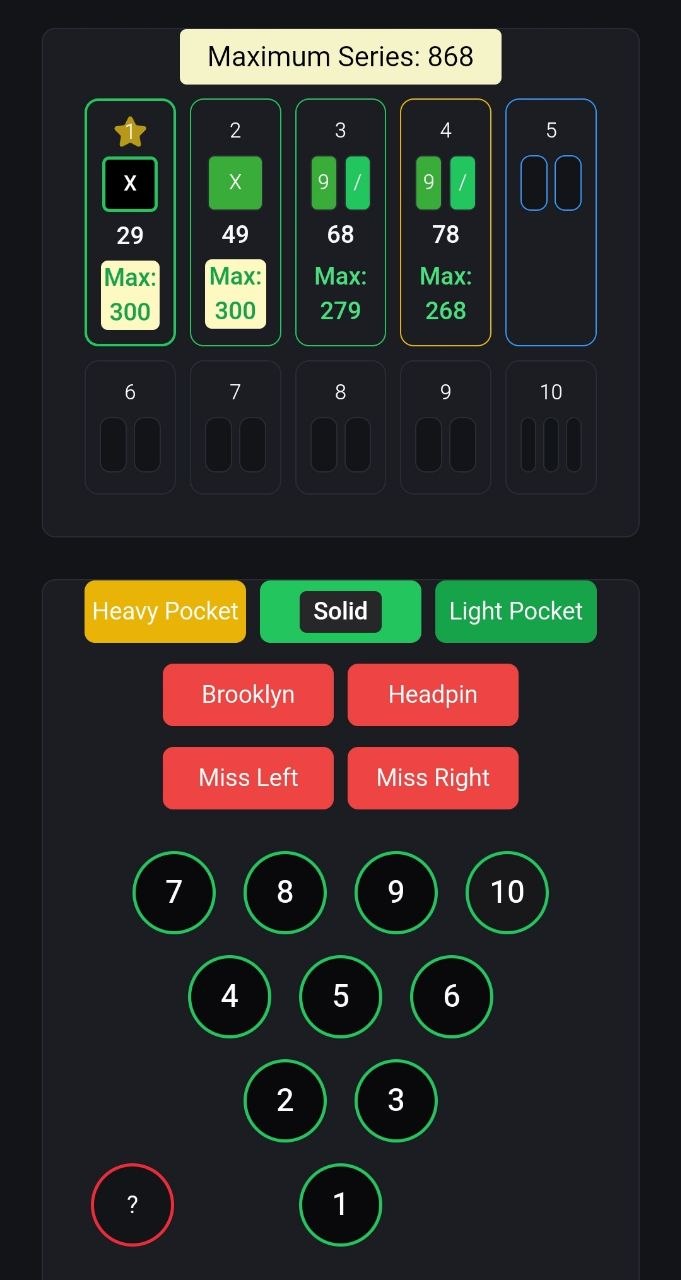
Tap in each shot and the running total, spares and strike bonuses are worked out for you.
Frequently Asked Questions
How do you keep score in bowling?
Each of the ten frames has two small boxes for the balls and one big box for the running total. Write pins knocked down in the small boxes, X for a strike and a slash for a spare, then fill the big box with the running total once any bonus balls have been thrown.
What do the symbols on a bowling score sheet mean?
X is a strike, a slash is a spare, a plain number is pins knocked down by that ball, a dash is a miss, F is a foul, and a circle round the first ball count marks a split. Some score sheets also use G for a gutter ball.
How many points is a strike worth in bowling?
Ten plus whatever your next two balls knock down, so a strike is worth between 10 and 30. A spare is ten plus your next one ball, so between 10 and 20.
What is the highest score in bowling?
300, from twelve strikes in a row. Each of the first nine frames is then worth 30, and the tenth frame with its two bonus balls is worth 30 as well.
Do you still need to keep score by hand?
The house machine does the arithmetic, so no. Plenty of league bowlers still keep a sheet or a score book because it makes you look at each frame as it happens, and because the machine throws its record away at the end of the night.
Is bowling scored the same in the UK and the US?
Yes. Ten pin bowling uses the same frames, the same bonuses and the same notation in UK leagues and under USBC rules. The vocabulary varies a little, with score sheet and score book used on both sides and tenpin often written as one word in the UK.
Keeping score is the first step. Turning those scores into something that tells you what to work on is the next one.
How to Track Your Bowling PerformanceLet the Scoring Take Care of Itself
The KB App keeps the score for you and records what the score sheet cannot: shot quality, pocket accuracy, spare conversion and how your game holds up across a session.
Start your free 28-day trial. No credit card needed.